Camps International: Where Impact Took Us in 2025
Camps International has published its 2025 progress update, looking back at the school expeditions, community partnerships and conservation work delivered by its travellers in 2025.
In 2025, 4,306 travellers joined a Camps International expedition, working alongside local communities in Kenya, Tanzania, Borneo, Ecuador, Peru, Costa Rica and Cambodia. Together, they contributed 269,964 hours of hands-on project work, supporting 91 community, conservation and environmental projects shaped and led by the communities themselves.
Building Better Futures Through Education
Education remained a central focus in 2025. Camps International’s school groups helped improve 26 schools and constructed or renovated 52 classrooms, taking the total number of classrooms built or improved over the years to more than 360. Forty new desks were added for children to learn at, and six new libraries and reading spaces were opened. In Cambodia, locally employed, Camps-funded English teachers delivered 2,900 hours of lessons in 2025 alone.
Beyond the classroom, teams built 7 new houses and renovated a further one, three community centres were built or improved, and two new bridges reconnected villages that are otherwise cut off during the rainy season.
Protecting the Planet
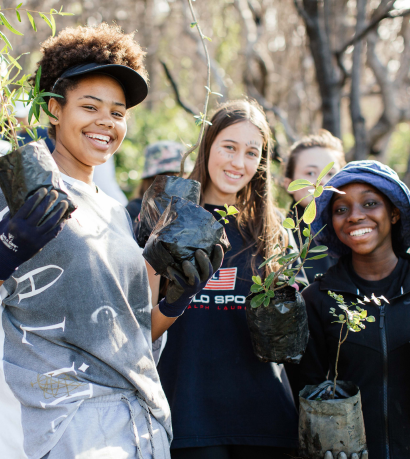
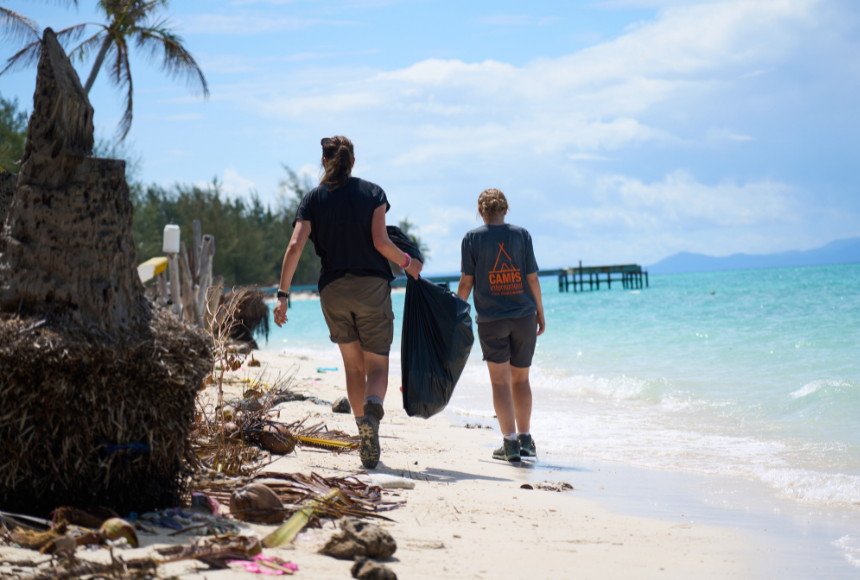
Environmental work remained central to Camps International’s expeditions in 2025. Travellers planted 4,119 trees across project sites, taking the total planted since 2004 to more than 1,019,000 trees. Along coastlines from Costa Rica to Borneo, teams removed 0.45 tonnes of marine plastic from local beaches, with 965 pieces of recycled flip-flop art created from waste collected on beach cleans.
Strengthening Communities
Access to clean water, sanitation and sustainable income continued to be a priority in 2025. Four new clean water initiatives gave 344 people access to safe water for the first time, while 36 toilets and three kitchens were built or improved, taking the total number of toilets and sanitation facilities built or improved to 373. In East Africa, 2,720 livestock were dewormed to help strengthen food security for local families, while in Cambodia 16 chicken pens were built for the same reason. Partner women’s groups also produced 600 sheets of elephant dung paper in 2025, turning a conservation by-product into a genuine source of income.
Project Spotlight: Tinangol Community Centre, Borneo
Some of the proudest moments in 2025 came from projects years in the making. Tinangol is a rural community in Sabah, Malaysian Borneo, where many of the village’s 100 households rely on small-scale farming, and where a proper gathering space had been missing for years. Camps International broke ground on a new community centre in 2017, designed to give Tinangol a home for meetings, gatherings and Native Court proceedings, the village’s customary local institution.
On 27 October 2025, the same week teachers from the UK were preparing for the 2026 season, the centre was formally handed over to the community. A UK Team Season 2025 group completed the final stage of work, finishing the toilets, drainage, floors, paintwork and windows, while local staff carried out the electrical wiring so the community has the skills and confidence to manage the building themselves. It took eight years of travellers returning season after season to get there, and it is a good example of what Camps International’s longer-term community partnerships are built on.
What Travellers Took Home
Impact runs both ways. At the end of every 2025 expedition, Camps International asks its student travellers how the experience shaped them personally. In 2025, 99% of the 1,399 students who responded said it grew them in at least one meaningful way, picking out four different areas of change on average.
Three themes came through clearly. 85% said the trip supported their personal growth and character, helping them become more independent, self-aware and courageous along the way. 81% said it broadened their global perspective, as they came home with stronger cross-cultural understanding and a wider view of the world. And 71% said it strengthened their empathy and sense of purpose, encouraging more compassion and a stronger desire to create positive change.
Beyond the numbers, students described what that growth meant to them personally. One said the experience made them realise how beautiful the planet is, while another described coming home with a realisation of how small their own problems were compared to those they had seen. It is this kind of personal change, alongside the physical projects completed, that keeps schools coming back year after year.
In Sharon's Words
“2025 has reminded us that lasting impact is not created in a single moment, but through thousands of small, consistent actions that build momentum over time. From a library opening its doors for the first time to a community gaining reliable access to clean water, every step matters. That patience, consistency and shared commitment is what our travellers and local teams deliver together each season, and it is what will carry us forward into 2026.”
— Sharon Palmer, Managing Director, UK & Middle East
Looking Ahead
Work for 2026 is already under way. A short distance from Tinangol, travellers are now focused on Timbang Batu, another community centre that has been years in the planning. A one cubicle toilet has already been built and construction of a sepak takraw court is under way, with full handover to the community planned for October 2026. It is the same sustained, partnership-led approach that delivered Tinangol, with progress building gradually from one team season to the next.
Tinangol is one example of what a sustained, partnership-led approach can build over time, and the same approach will continue into 2026 across Kenya, Tanzania, Borneo, Ecuador, Peru, Costa Rica and Cambodia, as travellers return season after season to build on the progress made in 2025.
This progress builds on the same sustained, partnership-led approach set out in Camps International’s Issue 4 Impact Report.
About Camps International
 Camps International is a social enterprise that balances profits with philanthropy. Camps operate a permanent network of international camps in the heart of rural communities and wildlife conservation areas through their wholly owned operations in Latin America, East Africa and Southeast Asia. Camps are located where poverty levels are high and/or significant environmental and wildlife conservation challenges exist. Most camps are established on community land, and they employ local people to build, staff and supply their camps, with each one acting as the hub from which they run their wide range of sustainable projects and adventure activities for young people from around the globe. Projects vary from constructing school classrooms and supplying drinking water to terrestrial and marine wildlife conservation, reforestation, environmental education and microfinance initiatives.